


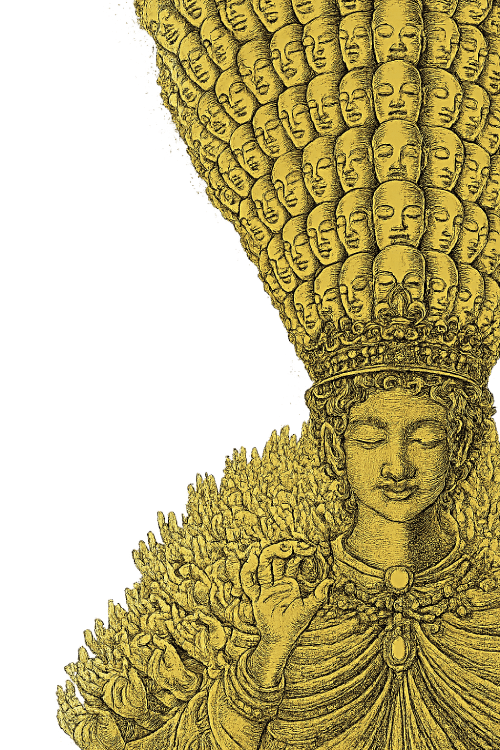
59.
Phra Pathom Chedi
“Lord Phoche, were there any other important events along the way?” I asked.
“Of course. The journey of the yellow-robed monks with a city ruler as a follower must
not have been ordinary, especially in the case of the Buddha and Phaya Asoka traveling
to create symbols so that Buddhism could establish itself in the Tai Lue, Tai Yai, Lanna,
and Lan Xang ethnic regions in the future. Everywhere the Buddha went to bury his
hair relics in the ground, it later became the location of a temple that enshrined the
Buddha’s relics. During the first half of the journey, Phaya Asoka built over a hundred
stone pillars, and almost all of them were in distant lands, starting from the
Pañcanagara Kingdom that I told you about, going up to Chiang Kham Nuea, Chiang
Kham Tai, Chiang Muan, Chiang Rai, Chiang Saen, the Lan Xang Kingdom, all the way to
Xishuangbanna, and turning west or to the north of present-day Myanmar: Mandalay,
Naypyidaw, Monywa, Myitkyina, Taungoo, Bagan, Taunggyi, turning back to Kengtung,
Jinghong, Wiang Haeng, Mae Hong Son, Chiang Dao, Chiang Mai (which was not yet a
city at that time), Lamphun, Lampang, Tak, Kamphaeng Phet, Nakhon Sawan, Uthai
Thani, Chai Nat, Sing Buri, Ang Thong, Suphan Buri, Kamphaeng Saen, until they
reached a major halfway point at Kosinarayana, which was Phaya Asoka’s own city,
located in the border area between Kanchanaburi and Nakhon Pathom provinces
today,” Lord Phoche explained.
“Wow! The Buddha traveled extensively, and so did Achita’s caravan. But wait! Is
Kosinarayana the same as Kusinara where the Buddha passed away?” I asked.
“Yes.”
“Then why is it only in Nakhon Pathom province?” I commented and questioned.
“I already told you that the entire history of Buddhism took place in your country and
neighboring countries,” Lord Phoche replied.
“Wow! Can I learn about the story of the Buddha’s passing first? And was Achita
involved in that event?” I asked.
“She wasn’t there because at that time she had chosen to be stationed in a city in the
Lanna region, near Hariphunchai. That city is currently known as Wiang Tha Kan, but
at that time it was called Chiang Kha or Chiang Sieo, located in San Pa Tong district,
Chiang Mai province. But after she learned of the Buddha’s passing, she rushed to
Kosinarayana. However, she arrived during the distribution of the Buddha’s relics to
various kingdoms. She was involved in the construction of the first *chedi* to enshrine
the Buddha’s relics, along with a Brahmin,” he replied.
“The first *chedi*? Where is it?” I asked.
“It is the first *chedi* to officially enshrine the Buddha’s relics. Therefore, that time is
considered the beginning of the Buddhist Era. That *chedi* is Phra Pathom Chedi,” he
replied.
“Really? Is that the origin of Phra Pathom Chedi? Can you tell me the details of the
story?” I asked.
“Yes. In the final stage of his life, the Buddha intended to pass away in Kosinarayana
because it was the city of Phaya Asoka, who was like an old Dharma friend who had
shared hardships and joys, traveling to lay the foundation of the Buddha’s religion in
various lands throughout the region for over twenty years. And the Buddha also knew
in advance that there would be a problem with the possession of the relics if he passed
away in another city. Phaya Asoka might receive only a small share of the relics, or
perhaps none at all, because Phaya Asoka’s city at that time was only a small city on the
border. The Buddha wanted Phaya Asoka to possess all the relics so that they could be
enshrined at the various points where they had previously prayed together. At that
time, the Buddha had already sent disciples to be stationed and spread Buddhism at
the various points that had been prepared in advance.”
“One afternoon in mid-May, about 1 year before the Buddhist Era, after the Buddha and
over twenty of his enlightened followers, with Ananda as his personal secretary, had
traveled from a small city called Pava (the current location of this city is Kamphaeng
Saen), he arrived at a *rang* forest just 11 kilometers before entering the city of
Kosinarayana. Due to exhaustion from the journey and illness from consuming
poisoned food that a villager in Pava had offered at his house that morning, the Buddha
ordered a rest because his symptoms worsened, making it impossible to travel further.
That place had a large stone platform with a flat and slightly sloping surface, suitable
for use as a resting place. So, the Buddha told his followers to spread a cloth on that
stone, and he lay down. And that night, the Buddha peacefully passed away around
midnight. Today, we know that place as Phra Thaen Dong Rang.”
“Phra Thaen Dong Rang…!!” I exclaimed in surprise because I had heard the name of
this place since I was a child, but I never knew its significance.
“Lord, this is one of the important holy sites for Buddhists! I think this must be a story
that will be greatly criticized if it is revealed because it is different from the knowledge
and beliefs of general Buddhists,” I commented.
“I don’t care what anyone says or what their reaction to this story is because it doesn’t
concern me. I’m just doing my job of telling the truth that you need to know,” Lord
Phoche said.
“You’re not forcing me to reveal these things, are you?” I said.
“It’s your right. Whether you speak or not is your business. But I know for sure that
this is your mission,” he said with a hidden meaning.
“Do you know that your words are making me feel afraid?” I expressed my feelings.
“I know that you and your true self will work together to communicate this story
intelligently because he came specifically to talk about this,” Lord Phoche said.
“Who do you mean? I’m starting to get confused,” I asked.
“I mean your true self, your spirit,” he replied.
“Uh… never mind, you don’t have to explain. What I’m interested in is whether there
will be any more surprising stories after this. Can you please continue?” I suggested.