


97.
Vajrayana
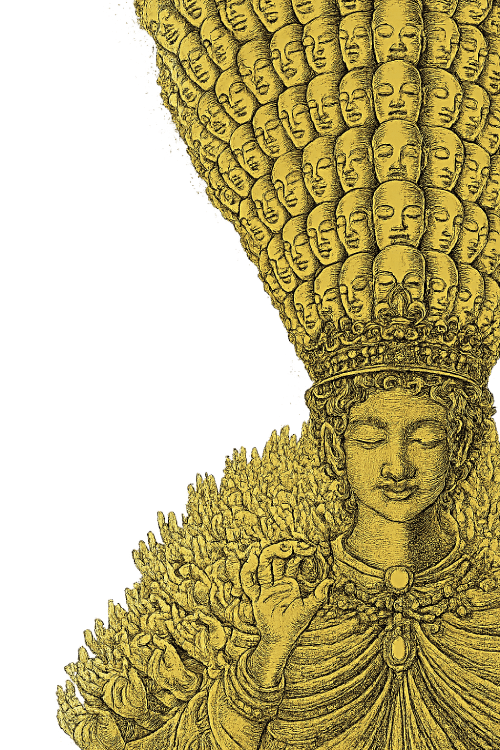
“Not a deity, but a soul,” he replied.
“Whose soul is it?” I asked.
“A person. You know him by the name Moggallana. He was like the right hand of the
Buddha. Once he attained Buddhahood, his extraordinary spiritual skills were used to
their full potential. His original soul possessed remarkable abilities to perform
miracles, skills he had accumulated from past lives. Coupled with his innate sharp
intellect, he could elucidate profound Dharma teachings to people through analogies of
things around them, by posing questions and guiding them to find answers themselves.
Sometimes, his questions were so direct they could shatter the shell of clinging to the
familiar or to human-like thinking. He could break down old belief systems, enabling
people to attain Buddhahood instantaneously.
This method is what you now call ‘Vajra’ or ‘Zen’. He established a monastic center in
the mountainous northern region of Thailand. From there, he dispatched hundreds of
trusted disciples to spread the teachings to distant lands, or present-day China. He is
therefore credited with laying the foundation for Vajrayana or Zen Buddhism in this
region. People revered Lord Moggallana as the great master of instantaneous
enlightenment,” Lord Phoche explained.
“Lord Moggallana himself? The originator of Zen Buddhism? Then why is his name
absent from the history of Zen?” I asked.
“It’s because his method discouraged attachment to individuals. Moreover, his life was
short; Lord Moggallana passed away before the Buddha. However, even in that brief
period, he trained a multitude of individuals who attained instantaneous Buddhahood.
These individuals then dispersed eastward and northward, to the areas that are now
Vietnam, China, Taiwan, Korea, and Japan. All of Lord Moggallana’s disciples became
renowned figures in later times and were highly regarded as experts in the art of Zen.”
“Why did Lord Moggallana pass away before the Buddha? Was he older?”
“He was not older, but he was assassinated. This was because certain Brahmins
recognized that Lord Moggallana was liberating people from fear, a method widely
used by Brahmins. Naturally, this undermined the interests of the Brahminical
establishment. They sent assassins, but due to Lord Moggallana’s extraordinary ability
to miraculously influence situations, the hired thugs were overcome with fear and
could not harm him.”
“Then why did he die?” I asked.
“The malicious individuals did not give up. They continued to send assassins
repeatedly, a second, third, fourth, and fifth time. Eventually, Lord Moggallana realized
it was futile to evade them, as this was a past karmic debt that had to be repaid. He thus surrendered to his adversaries. In that encounter, he was severely injured. An
ordinary person would have died instantly, but his spiritual power allowed him to
sustain himself and recover enough to remain alive. He then journeyed back to the
Buddha, but due to his severe injuries and the exhaustion from the journey, he passed
away shortly after arriving, right in front of the Buddha, just a few months before this
very gathering. Therefore, today, Lord Moggallana is the only one present whose
existence is purely soul,” Lord Phoche explained.
“Speaking of distant lands or present-day China, there is another significant figure. It
would be remiss not to mention him, as he played a crucial role in widely propagating
Buddhahood, covering a geographical area many times larger than the Buddha
himself.”
“Who is he?” I asked.
“Before he embarked on his journey to spread Buddhahood to those distant lands,
when he was still residing with the Buddha, he was a handsome young man with fair,
radiant skin and a dignified bearing. At times, people mistook him for the Buddha.
Wherever he went, he was surrounded by crowds, especially young women and female
lay devotees. Besides being handsome, eloquent, and good-humored, he also possessed
the skill to explain Buddhahood concisely and understandably, suitable for the general
populace. This contrasted with the Buddha’s explanations, which often detailed the
origins and reasons in a comprehensive manner, more suited for those who were
highly educated and seeking profound spiritual understanding.”
“Because of his attractiveness, he drew many young women to him, but they came with
desires other than to discuss the Dharma. Some would watch over him daily to assert
their claim, observing others who might show affection towards him. They would find
ways to exclude rivals, sometimes engaging in gossiping and slander, leading to
quarrels. When he spoke of someone in particular, jealousy would arise, disrupting the
peaceful atmosphere of his residence. He thus decided to do something about it,
seeking permission from the Buddha:
‘Venerable Lord Buddha, I request permission to consume more food so that my body
becomes stout, which is a violation of the dietary practice that Your Holiness has
established, that monks should eat moderately and not overeat,’ he stated his intention
immediately upon meeting the Buddha.
‘My son, why do you contemplate such a thing?’ the Buddha asked.
‘Those who come to hear the Dharma from me do not hear the truth that emanates
from my mouth. They do not see the truth that I am revealing to them. They do not
appreciate the nectar of the Dharma, the noble spiritual state that I am transmitting to
them, because my physical form obscures it completely,’ he replied.
When the Buddha understood his purpose, he granted his request. It took him nearly
two years to transform from a lean, well-built physique to a portly, pot-bellied figure,
and from a slender, handsome face to a round, chubby one.”
“Who is he? What is his name?” I asked.
“You know him as the venerable Kaccayana, but the common people in mainland China,
the land he traveled to, called him ‘Sangkaccayana’. This image is of a stout monk with
a contented, cheerful face, and he became a symbol of wealth and abundance. He was
the one who initiated the spread of Mahayana Buddhism in China,” he replied.
“Ah, yes… the venerable Sangkaccayana. I’ve seen his image since I was a child. So he
was actually Kaccayana, one of the chief disciples,” I remarked.
“After the Buddha completed the spiritual volunteering on this day, everyone departed
for various regions to propagate the concept of Buddhahood. One of them was the
venerable Kaccayana, who journeyed to China. And the phrase you often hear
associated with Sangkaccayana is ‘Amitabha Buddha,’ a term that holds significance
related to his story and yours,” Lord Phoche elaborated.